











TL;DR: Spiked shoes were invented in the 19th century to improve traction, now use ultra light materials and carbon plates that increase efficiency and reduce energy dispersion, improving performance by up to 2%. However, their effectiveness depends on the athlete's strength and technique: they amplify the qualities of those who know how to run well, but they do not compensate for poor mechanics. For beginners, they should be introduced gradually to avoid injury. Technology helps, but it is the athlete who makes the difference.
WHAT ARE SPIKED SHOES?
Invented in the second half of the 1800s, spiked shoes were designed to create greater traction on the ground, helping athletes produce better grip, greater acceleration, and overall improved performance, results that would not be achieved with normal training shoes.
Over the last century, alongside the evolution of running tracks, shoe materials have evolved to help athletes achieve maximum performance and results.
If we want to make a concise distinction between performance shoes and simple jogging shoes, we can say that the former are designed to provide tangible assistance in terms of ground impulse and minimizing energy loss, while the latter are more focused on comfort and cushioning.

DESIGN PRINCIPLES
What principles guide the design of track spike shoes? The key words are lightness, rigidity, and traction.
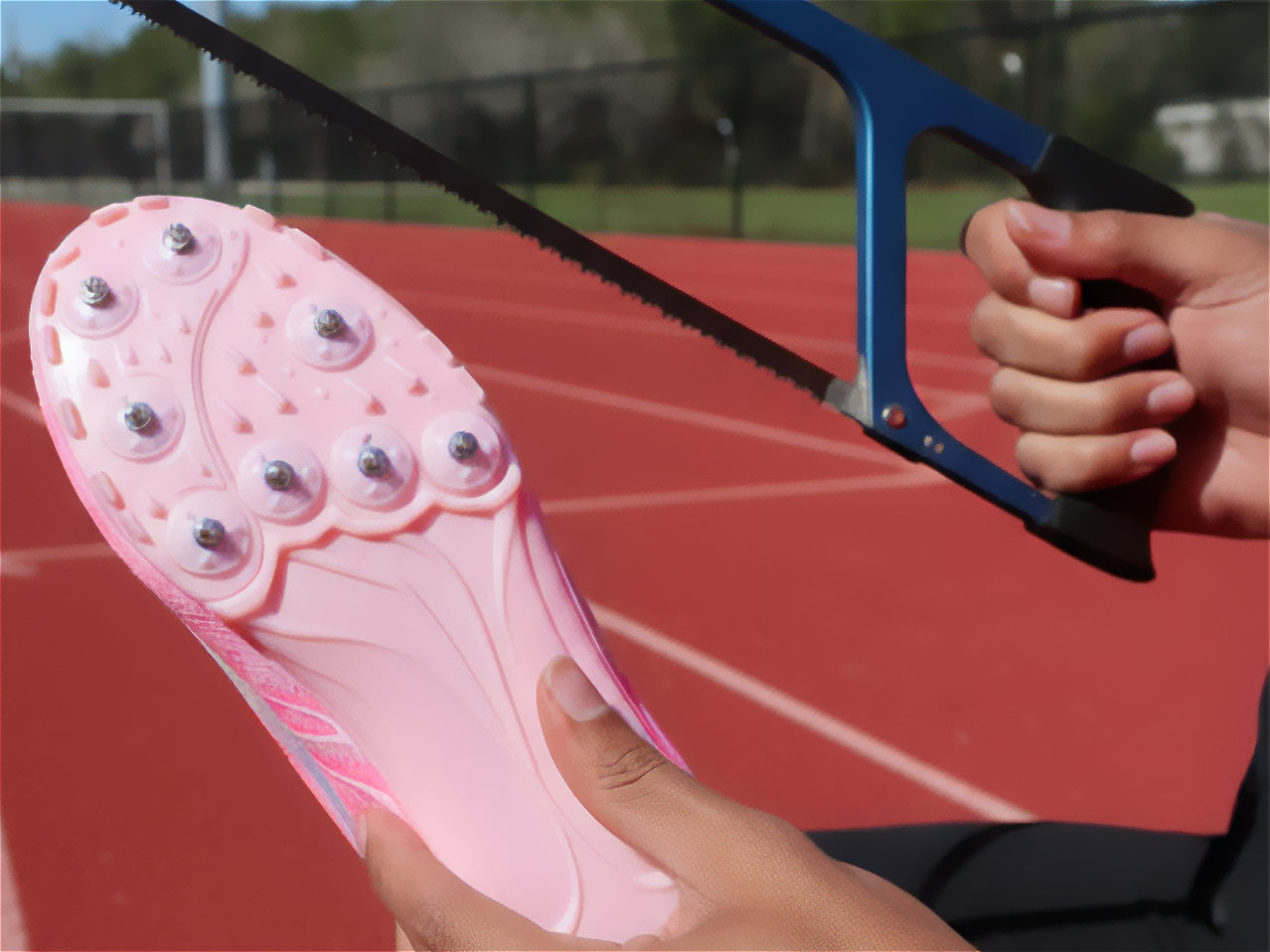
The design is often sinuous and aerodynamic, with synthetic materials that make the shoe very light overall. A striking example was the 2012 Adidas SP, which weighed only 99 grams. The upper is becoming increasingly important in reducing weight and preventing deformation, mesh and carbon filaments are currently used to counteract the forces exerted by the foot on the upper structure during running. Directly below the upper, we usually find an insole on which the foot rests, a double layer midsole (i.e., carbon and supercritical foam), and finally a thermoplastic outsole with removable or non removable spikes, the final point of construction that first interacts with the ground, "clinging" to it and creating traction.
I would like to briefly mention foams, as they also play a fundamental role nowadays.
The technology of running foams currently peaks with PEBA (polyether block amide) thermoplastic elastomer, which is the main foam used in modern spiked shoes and, in general, all those with added carbon. PEBA is the most popular after:
- EVA (ethylene vinyl acetate), which, however, undergoes polymerization at low temperatures, thus increasing rigidity. In practical terms: running on asphalt with EVA foams in low temperatures is not good for your feet at all.
- TPU (thermoplastic polyurethane).
PEBA has better rebound resilience, superior cushioning properties, and is lighter than other foams. However, PEBA deteriorates more quickly as the shoe wears out and is more expensive to produce.

THE IMPORTANCE OF CARBON
However, the real secret weapon lies in the carbon plates, whether internal or external.
First of all, why does the carbon plate make you run faster?
The rigid carbon plate reduces dorsal flexion of the toes and metatarsophalangeal joints. This reduces energy consumption in these joints, which can then be redirected for forward movement.
Another significant effect of the carbon fiber plate on performance is that its rigidity and lack of flexion shift the ground reaction force forward. This creates a "longer lever arm" with which to apply force, from the point of impact to the ankle. The stiffer plate increases the joint moment of the ankle.
One hypothesized advantage of curved carbon fiber plates is the "seesaw" effect: when the center of pressure moves forward toward the end of a curved carbon fiber plate in the stance phase and the runner pushes off from the toe, the ground reaction force produces a force on the heel that helps lift the heel off the toe.
The use of a stiff carbon plate also reduces the speed at which the medial gastrocnemius (part of the calf) must contract, potentially lowering the energy cost of running.
During long distance running, the body naturally transfers work from the lower body (plantar flexor muscles of the ankle) to the larger upper muscle groups (knee extensor muscles) as it becomes fatigued. This redistributed workload is less efficient as it involves larger muscle groups. Shoes with carbon plates seem to delay this transition until the later stages of running, with a positive impact on performance.
In 2004, Darren Stefanyshyn and Ciro Fusco published "Increased Shoe Bending Stiffness Increases Sprint Performance," perhaps the cornerstone research of the early 2000s. Using four increasingly stiff insoles, they had selected athletes sprint 40 meters and studied any improvements.
They concluded that the flexural stiffness of sprint shoes appears to affect sprint performance. However, an excessive increase in stiffness could negate the benefits.
They hypothesized that specific characteristics, such as the force length and force velocity properties of individual athletes' calf muscles, could be related to the stiffness of the shoes needed to achieve maximum performance. However, in the end, they recommended that athletes and coaches experiment with shoes of varying degrees of stiffness to achieve optimal performance.
What this means is that, despite everything, it is the athlete who makes the difference.
THE ATHLETE AT THE CENTRE OF PERFORMANCE
In general, research in 2022 highlighted an average beneficial effect of 1-2% with spiked shoes. However, running too slowly or having insufficient technique renders them ineffective.
In summary high performance shoes need the right athlete to extract the full potential from the proposed technology. Running speed, force discharged to the ground, weight, and comfort all affect the final performance.
The use of spiked shoes is essential for maximum performance. At a high level, marginal gains in traction and efficiency are crucial for breaking records or winning races. Elite athletes often have the muscle development and technique to cope with the stiffness and lack of cushioning.
It's a different story for beginners, especially young people. Beginners will also benefit from the increased grip and lightness. However, it is important to proceed with caution. Stiffness and forced forefoot strike can place significant stress on the calf muscles, Achilles tendon, and foot muscles. Beginners should introduce them gradually, initially only for races and high intensity training, and continue to use cushioned shoes for most of their training.
Since spikes require greater muscular and tendon effort, a dynamic warm up specifically for the feet and calves is essential to prevent injuries.
Spiked shoes do not correct running flaws; instead, they enhance efficiency, which is completely negated by poor technique. It is therefore advisable to learn how to run properly first and then use spiked shoes.
Would you like to know how much faster you could theoretically run with today's spiked shoes compared to normal sneakers? Do Track Spikes Make You Faster Calculator.

About the Author
Alessandro Bacci
An accomplished sprint and hurdles coach with extensive experience across Italy’s top athletic institutions. He currently serves as sprint coach for the Italian Navy Academy and track & field practice teacher at the University of Pisa. Alessandro also coaches at Atletica Livorno 1950 and collaborates with the Regional Technical Sector of Tuscany, contributing to the development of elite athletes across the region.
Read more about Alessandro →